
Heineken UK has cut CO2 emissions intensity at its Manchester brewery by 42% after investing £28.2 million in large-scale industrial heat-pump technology. The site is Heineken’s largest UK brewery, and it produces around 2.5 million pints a day.
The result raises a wider question for the brewing industry. Can brewery decarbonisation heat pumps deliver similar gains at smaller breweries, where energy demand, capital budgets and production volumes differ significantly?
How Do Industrial Heat Pumps in Brewing Work?
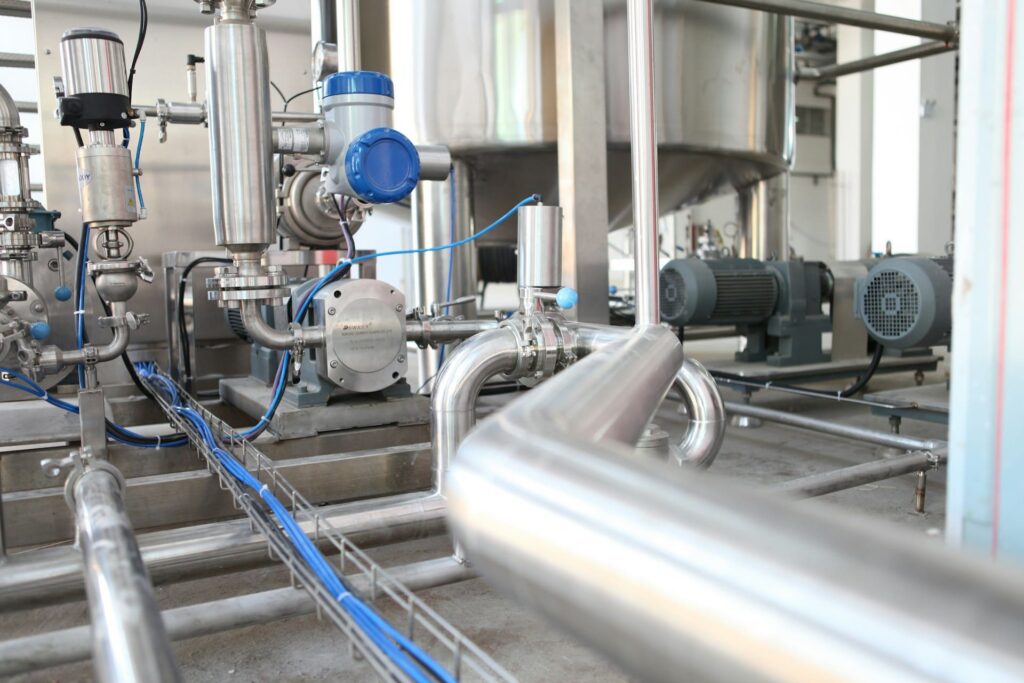
Industrial heat pumps do not generate heat by burning fuel. Instead, they capture existing heat from air, water or waste process heat, then use an electrically driven compressor to raise that heat to a useful temperature.
The European Heat Pump Association describes the cycle as similar to a refrigerator running in reverse. Heat pumps can typically deliver around three units of heat for every unit of electricity consumed, while a gas boiler needs roughly 1.25 kW of gas to produce 1 kW of heat, according to sustainability consultancy NIRAS.
Brewing presents a tougher challenge because different stages need different temperatures. Wort heating, boiling and pasteurisation can require temperatures at or above 100°C, while fermentation and cooling produce lower-temperature waste heat.
Research published in ScienceDirect identifies industrial heat pumps as a potential route for decarbonising process heat below 300°C, while newer high-temperature systems can reach higher outputs than earlier generations.
That makes heat pumps a potential tool for brewery decarbonisation across several heat-demanding stages.
Brewery Decarbonisation Heat Pumps: The Results Behind the 42% Cut
The Heineken Manchester brewery cut on-site natural-gas consumption by 33%, contributing to a 42% reduction in CO2 emissions intensity between July and December 2025, compared with the same period in 2024, according to Heineken UK.
The heat-pump network was commissioned in June 2025 after installation began in 2023. The brewery has now entered a 12–18 month optimisation phase.
Heineken says the system already delivers an average of 80% of its estimated on-site gas-reduction target, according to Supply Chain Director Chris Kerr. The £28.2 million project combined company capital investment with £3.7 million from the UK government’s Industrial Energy Transformation Fund.
Heineken describes the installation as the first retrofit of its type and scale across its global operations.
Could Smaller Breweries Use This Technology Too?
Heineken’s £28.2 million investment reflects the scale and resources of a major industrial brewery, so most independent producers are unlikely to replicate the Manchester retrofit.
Yet the underlying principle behind brewery decarbonisation heat pumps can work at smaller sites. Colorado’s New Belgium Brewing has prepared to replace several boilers with a heat-pump system that its carbon-neutral engineer estimates could cut natural-gas use at the site by more than 90%.
NIRAS Sustainability Consultant Mike Bannerman says, “Heat pumps have huge potential to decarbonise in a cost-effective way, but they need to be matched to the right processes,” noting that brewers can be unsure where to begin.
Smaller breweries can focus on recovering waste heat from cooling and fermentation, then reusing it elsewhere in production. Specialist engineering firms already advise breweries of different sizes on appropriately scaled systems.
What This Means for the Path to Net Zero Brewery
Heineken positions the Manchester project as one contribution to its Brew a Better World strategy and ambition to reach net zero across its value chain by 2040, according to Heineken UK Corporate Affairs Director Sonia Thimmiah.
The results also provide a measured case study for tackling brewing’s difficult process-heat emissions and advancing brewing CO2 emissions reduction. For the wider industry, the project shows how recovering and reusing heat can form part of a broader decarbonisation strategy.
The Beer Post tracks the investments and technologies influencing brewing’s future. Stay up to date with the next industry development. Get in touch with The Beer Post and discover how we can help your business access the global beer market!